

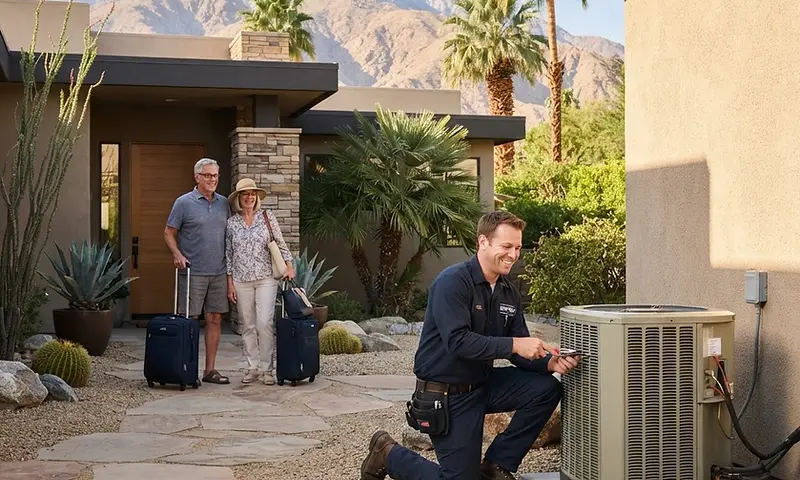
Your desert home has been sitting closed up for months. Before you settle back in, here's how to wake up your heating and cooling system the right way.
Welcome back to the Coachella Valley! After a summer up north, there's nothing better than returning to clear skies and mild afternoons. But while you were away, your heating and cooling system was sitting through the hottest months of the year, often set to a high temperature or switched off entirely. A few simple steps before you get comfortable can help your system start smoothly and keep your first weeks back stress-free.
Here's the start-up routine we recommend to our seasonal customers. Most of it takes less than an hour, and none of it requires tools beyond a flashlight.
Step 1: Walk Around the Outdoor Unit
Before you touch the thermostat, take a look at your outdoor condenser or heat pump. Months of wind can pile leaves, palm fronds, tumbleweeds, and sand against the cabinet. Clear anything within a couple of feet of the unit so it can breathe freely.
- Look for signs of critters, such as nesting material, droppings, or chewed insulation on the refrigerant lines
- Check that the unit is sitting level on its pad
- Make sure landscaping, irrigation lines, and new plants haven't crowded the unit
- Note any bent fins, loose panels, or damaged wiring, and leave those for a technician
Tip: Rodents love quiet homes. If you see chewed wiring or insulation anywhere near your equipment, don't run the system until it has been inspected.
Step 2: Replace the Air Filter
Even with the house closed up, desert dust finds its way inside. Swap in a fresh air filter before the system runs for any length of time. A clean filter protects the blower and coil, keeps dust from circulating through your freshly opened home, and helps the system move air the way it was designed to.
If you can't remember when the filter was last changed, that's your answer: change it now, and write the date on the frame so next time is easy.
Step 3: Check the Thermostat
Many thermostats run on batteries, and a long absence is often when they give out. Replace the batteries if your model uses them, then confirm the date, time, and schedule are correct. If you used a vacation setting or a remote app to manage the house while you were gone, switch it back to your normal at-home schedule.
Have a smart thermostat? Make sure it's still connected to your Wi-Fi network, especially if your router was unplugged or replaced over the summer.
Step 4: Look Inside at the Indoor Unit
Your air handler or furnace is usually in a closet, garage, or attic. With a flashlight, check for water stains, rust, or standing water around the base. A clogged condensate drain line is one of the most common problems we find after a long summer, and catching it early can prevent water damage to ceilings and floors.
While you're there, make sure nothing has been stored against the unit and that its access panels are firmly in place.
Step 5: Run Each Mode and Listen
Now it's time to turn things on. Set the system to cool and let it run for a while, then do the same with heat. Desert evenings cool down quickly this time of year, so you'll want to know your heat is ready before the first chilly night.
- Feel the vents: air should be noticeably cool in cooling mode and warm in heating mode
- Listen for grinding, squealing, rattling, or repeated clicking
- Watch that the system starts and stops normally instead of turning on and off every few minutes
- Walk through each room to confirm air is flowing from every vent
A faint dusty odor the first time the heat runs is normal. For anything stronger or unusual, our guide to heater smell warning signs explains what each one means. And if your AC runs but the air never gets cold, start with our article on what to check when your AC is not blowing cold air.
Step 6: Test Your Safety Devices
Press the test button on every smoke and carbon monoxide detector in the house. If your home has a gas furnace, water heater, or fireplace, a working carbon monoxide detector near sleeping areas is a must. Replace batteries as needed.
When to Call a Professional
The checklist above covers what homeowners can safely do on their own. A professional start-up visit goes further: checking refrigerant levels, electrical connections, capacitors, burners, the heat exchanger, and drain lines, so small issues get fixed before they turn into a mid-season breakdown. If you'd like a printable version of the homeowner steps, our HVAC maintenance checklist has you covered.
The easiest way to make every return stress-free is to join one of our maintenance clubs. Members get regular tune-ups scheduled for them, so your system is checked and ready when you arrive. See what each club includes on our maintenance plan page, or call us at (760) 773-3629 and we'll get your start-up visit on the calendar.
Frequently Asked Questions
Should I leave my AC on while I'm away for the summer?
Most seasonal homeowners leave the system running at a higher setting to keep heat and humidity from damaging the home and its contents. The right setting depends on your home, so ask our team during your next visit and we'll recommend one that suits your property.
What if my system won't turn on when I get back?
Check that the thermostat has power and fresh batteries, the breaker hasn't tripped, and the outdoor disconnect is switched on. If it still won't start, turn it off and give us a call rather than resetting it repeatedly.
When should I schedule a start-up tune-up?
Ideally a week or two before you arrive, or as soon as you're back. Booking ahead means your home is comfortable from day one, and any repairs can be handled before the busy season.
Join a Maintenance Club
Let us handle the tune-ups so your system is ready every season.
All Valley Air Team
All Valley Air Conditioning & Heating


